Cross-posted. This article’s canonical home is Data Lakehouse Hub.
The Rise of Agentic Analytics: Shifting BI from Passive Dashboards to Goal-Directed Action
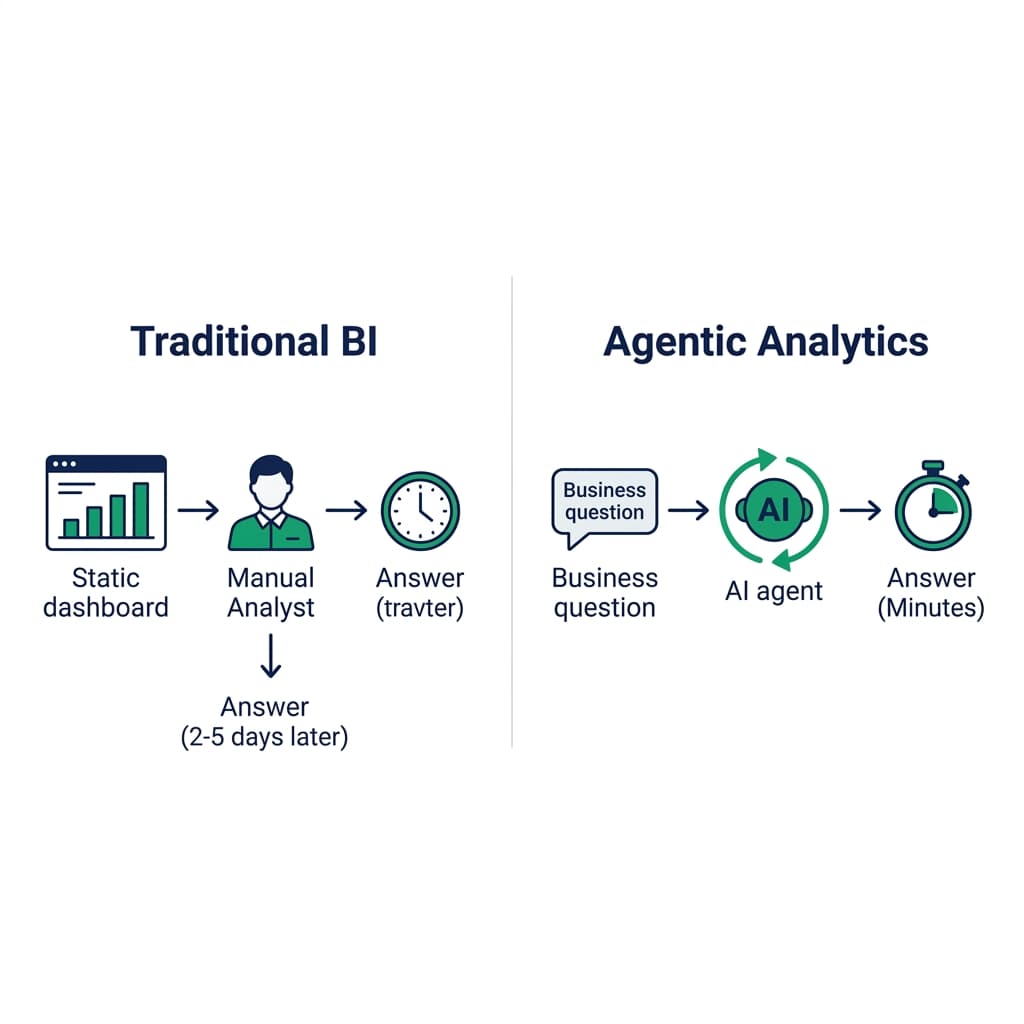
Dashboards have a fundamental design problem: they answer the question the designer anticipated, not the question the business needs answered today. A revenue dashboard shows you revenue is down 12% this month. It doesn’t tell you which product line, which region, which customer segment, which sales motion : unless someone thought to build that drill-down when they designed the dashboard six months ago.
The analyst fills the gap. They open the dashboard, see the anomaly, download the CSV, write Python or SQL, iterate through hypotheses, and two hours later produce an answer. Sometimes the answer prompts another question. The cycle repeats.
Agentic analytics replaces the human iteration cycle with an autonomous agent that pursues the business question until it has a defensible answer.
What Makes Analytics “Agentic”
Traditional BI is reactive and passive. A user asks a question; the system returns a fixed result. The query runs, the chart renders, and the session ends. The system holds no state between queries. It doesn’t remember what was asked before or adjust its behavior based on what it learned.
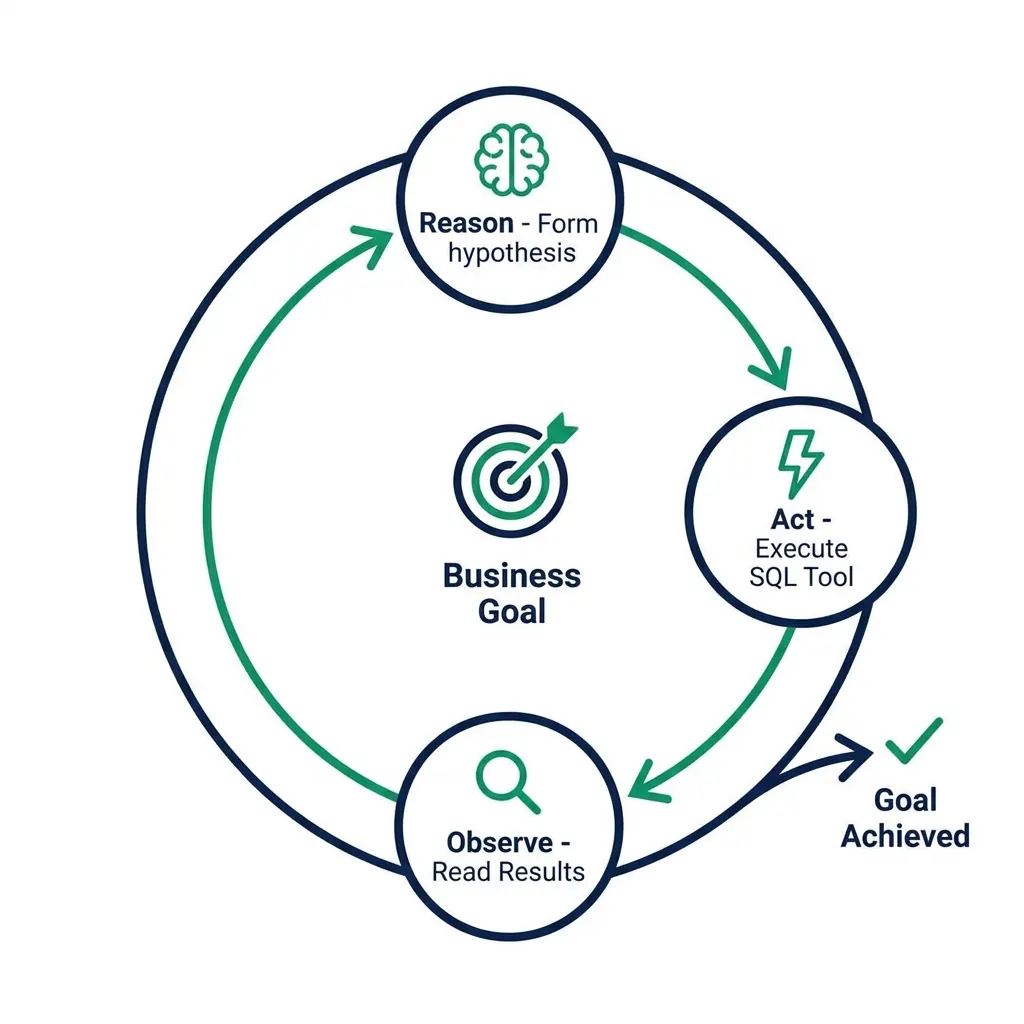
An agentic analytics system is goal-directed and iterative. You give it a business objective : “identify the cause of the 12% revenue drop this month” , and it runs a reasoning loop to pursue that objective. The loop looks like this:
- Decompose the objective into a sequence of hypotheses
- Write SQL to test the first hypothesis
- Run the query and examine the results
- Determine whether the hypothesis is confirmed, refuted, or inconclusive
- Adjust the next hypothesis based on what was learned
- Repeat until the objective is satisfied
The agent writes the queries, runs them, reads the results, and decides what to ask next. This is qualitatively different from a chatbot that translates one question into one query. The agent maintains context across a multi-step investigation.
The Bottleneck Traditional BI Creates
Static dashboards require analysts as intermediaries between business questions and data. That intermediation creates a throughput bottleneck.
A typical analytics team with 10 analysts supports hundreds of business stakeholders. Each stakeholder generates multiple requests per week. Analysts prioritize the highest-impact requests, leaving others waiting. The average request-to-answer cycle in most organizations is 3–5 business days.
During those 3–5 days, business conditions continue to change. The answer delivered on day 5 is based on data from day 1. In fast-moving markets, that lag makes the answer less useful than the delay suggests.
Agentic analytics removes the analyst as the bottleneck for defined categories of analytical work. Root cause analysis, anomaly investigation, metric decomposition, and cohort comparison are all structured enough that an agent can execute them reliably. Analysts shift to defining the questions and reviewing the outputs, rather than performing the investigation manually.
What Agentic Analytics Requires From the Data Foundation
An AI agent is only as accurate as the data it works with and the context it has about that data.
The failure mode is well-documented: give an LLM direct access to raw data files with generic column names like col_23 and amt_usd_2024_q3, and it generates plausible-sounding SQL that often returns wrong answers. The model doesn’t know what amt_usd_2024_q3 means in your business context.
Three things fix this:
Semantic context: Your data catalog needs human-readable documentation at the table and column level. What does this table contain? What does this column measure? What business term does it map to? This context is what allows the agent to translate a business question into correct SQL. Dremio’s semantic layer : built from virtual datasets, wikis, and labels , provides exactly this context.
Consistent metric definitions: “Active user” should mean the same thing everywhere. Define canonical metrics as virtual datasets in your catalog. The agent uses the virtual dataset, not the raw table, when answering questions about active users. Consistency eliminates the class of errors where different queries answer the “same” question with different logic.
Broad data access without data movement: An agentic analytics system that can only see data in one warehouse answers only the questions that warehouse can answer. Dremio’s query federation connects the agent to all your data sources : operational databases, cloud warehouses, data lakes, SaaS APIs , through a unified semantic layer. The agent can join Salesforce opportunity data with Snowflake revenue data with Iceberg transaction history in a single investigation.
Goal-Directed Search vs. Single-Query Response
The architectural distinction between agentic analytics and text-to-SQL is the search loop.
Text-to-SQL converts one natural language question to one SQL query. It’s stateless. The quality of the answer depends entirely on whether that single query captures the full analytical intent.
A goal-directed agent runs an iterative search. It generates an initial query, evaluates the result, decides whether it needs to refine the query or ask a follow-up question, and continues until the goal is satisfied or the agent determines it lacks the data to satisfy it.
The search loop also enables self-correction. If a query returns an error, the agent reads the error message, diagnoses the problem (wrong column name, type mismatch, missing join condition), and retries with a corrected query. Analysts do this instinctively. Agentic systems do it systematically.
Automated Workflows: Beyond Investigation
Agentic analytics extends beyond on-demand investigation. The same agent architecture that investigates anomalies can run on a schedule, monitoring KPIs autonomously and triggering investigations when metrics move outside expected ranges.
An agent configured to monitor daily revenue can:
- Detect a drop at 9 AM when the overnight batch completes
- Investigate root cause using the iterative query loop
- Identify that three specific customer accounts had processing failures
- Generate a summary with the relevant account IDs and estimated revenue impact
- Send that summary to the account management team before 10 AM standup
No analyst needs to notice the anomaly, prioritize it, and start an investigation. The work happens automatically in the time between the data landing and the team starting their day.
Dremio’s Agentic Lakehouse platform supports both the on-demand and scheduled variants of agentic analytics, with the semantic layer providing the consistent context the agent needs to operate reliably.
What This Means for the Analytics Team
The rise of agentic analytics doesn’t eliminate the analyst role. It changes it.
Manual query writing, dashboard maintenance, and stakeholder interview cycles become a smaller part of the job. System design : defining the semantic layer, configuring the agent’s investigation patterns, reviewing outputs, and catching errors the agent makes , becomes a larger part.
Analysts who adapt will handle 10x the analytical throughput with the same team size. The shift requires learning to evaluate agent-generated analysis rather than generating it directly, and learning to define the context that makes agent outputs trustworthy.
Try Dremio Cloud free for 30 days and run your first agentic analytics workflow against your existing data.